What is a total reward statement and how do you keep it up to date?


Benefits are the second biggest people cost after salaries. But only 36% of UK employees say they fully understand their benefits, down from 44% the year before.
When staff can't see what their compensation package is worth, salary is the only number they compare. A higher salary elsewhere looks like a better offer, so they start looking, without seeing the full value of what they already get. A total reward statement fixes that by showing each person everything their employer spends on them.
A statement is only as accurate as the data underneath it. One produced as an annual document shows what the package was worth on the day it was made. Months later it can miss a pay rise or a new benefit. An undersold package affects whether people feel fairly paid, how motivated they are and how they weigh it up when deciding whether to stay.
Below, we cover what total reward includes, what a statement should show, how to create one and how to keep it up to date all year.
What is total reward?
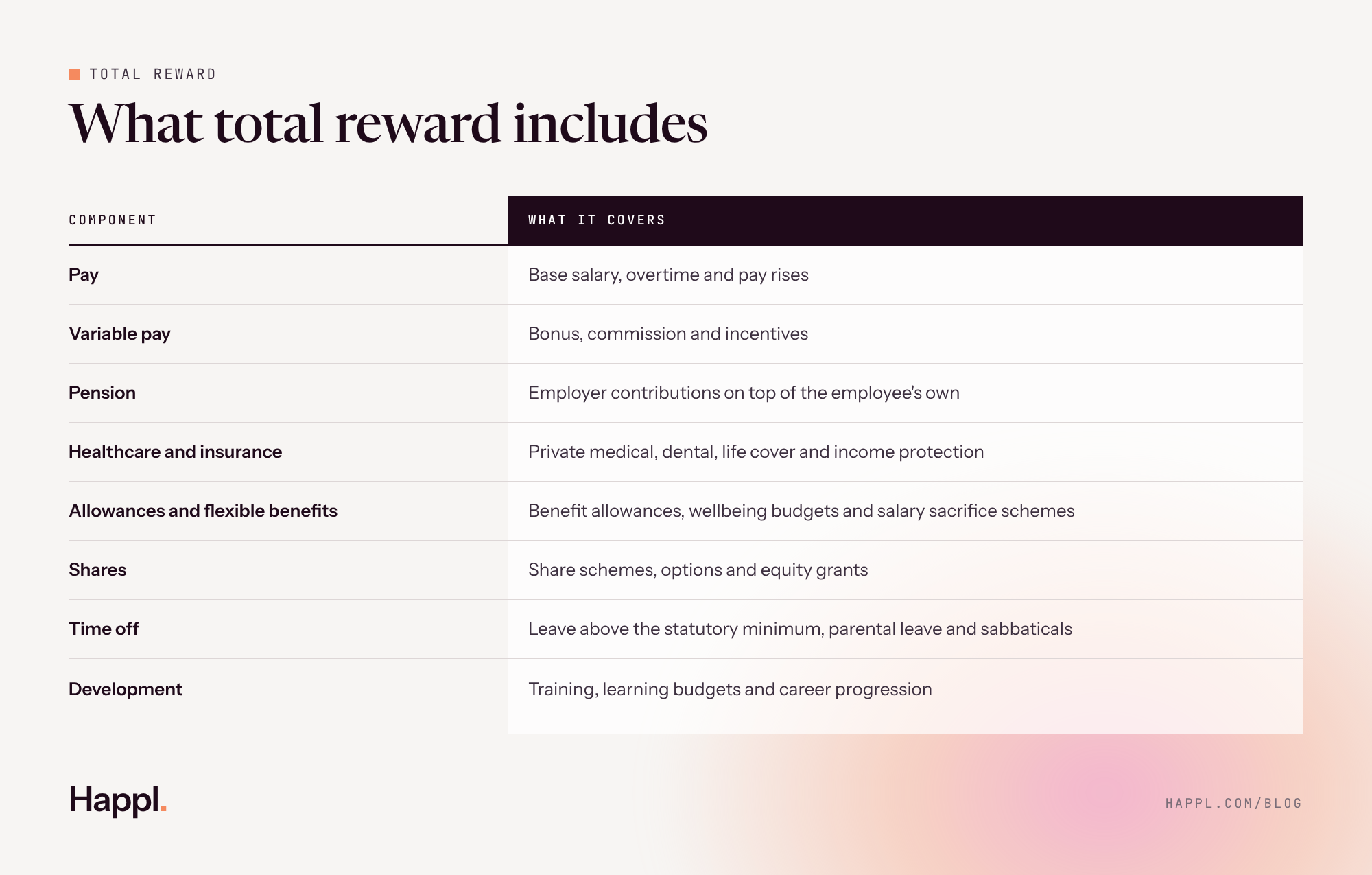
Total reward is everything an employer gives people in return for their work. The CIPD describes it as the tangible and intangible aspects of work that people value. In practice that means pay and bonus, but also pension, healthcare, insurance, allowances, shares, leave and the chance to develop.
Salary is the part people see every month. The rest is easy to lose sight of, even though most UK employers spend 20 to 30% of an employee's base salary on benefits and employment costs.
What is a total reward statement?
A total reward statement is a personalised summary of everything an employer spends on one person. It puts salary next to pension contributions, healthcare, insurance, allowances, shares and leave, each with a value. The employee sees what their whole package is worth, not only what lands in their bank account.
Someone weighing up a job offer can compare two salaries in seconds. Comparing two pensions, two health policies and two leave allowances takes work, so it's easy to skip. A statement puts all of it in one place, next to the salary, so the comparison is fair.
It's also becoming a compliance question. Under the EU Pay Transparency Directive, benefits paid in cash or in kind can count as pay. Employers who already show people their whole package will find pay conversations easier to have.
What should a total reward statement include?
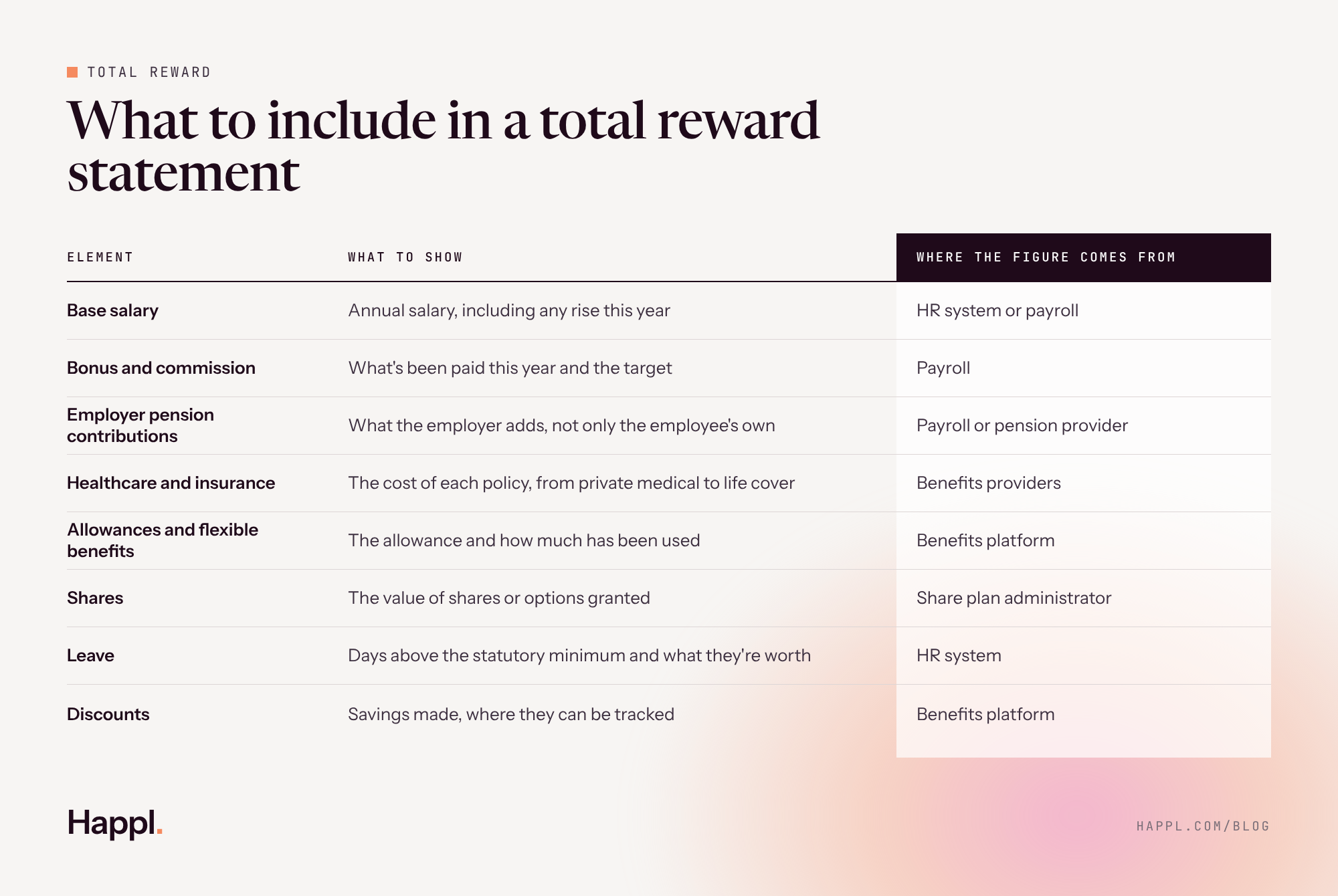
A total reward statement should include every part of pay and benefits that has a value to the employee, with the figure the employer spends on each. The core elements are base pay, bonus, employer pension contributions, healthcare and insurance, allowances, shares and leave.
People employed through an employer of record (EOR) belong on a statement too. Their pay and benefits data sits with the EOR provider, so it has to be brought in separately.
Look at the last column. A single statement draws on four or five different systems, and that's where most of the work is.
How do you create a total reward statement?
Most of the work in a total reward statement is gathering the figures and deciding how to value them. The steps below run in order, with the design near the end.
- Decide who it covers. All employees, or one country or group to start with. Include EOR staff if you have them.
- List the elements. Use the table above as a starting point and add anything specific to your package.
- Find the source of every figure. For each element, name the system it comes from and who looks after it.
- Decide how to value each benefit. You can show what the benefit costs the employer, or what it would cost the employee to buy themselves. Employers typically show what it costs them, as it's easier to work out from the figures they already have. Value to the employee is often higher but needs a clear method behind it. Pick one and use it throughout.
- Build the statement. Put the total at the top, then each element underneath in plain language.
- Send it when people will read it. The pay review is the obvious moment. Onboarding is another.
- Decide how it gets refreshed. A statement made once starts to date the next time anything in the package changes.
Done by hand, that means chasing figures from four or five systems and rebuilding the statement every year. In Happl, each person's statement is built from the data the platform already holds, from their HR record to the benefits they're enrolled in. Employers choose what's shown on it.
Should a total reward statement be annual or updated in real time?
An annual total reward statement is a snapshot of the package on the day it was made. A real-time statement updates as the data under it changes, so it stays accurate after a pay rise, a new benefit or a change in circumstances. Annual is simpler to start with. A real-time statement is more useful to the person reading it.

The difference matters when someone has a reason to look. That might be a pay review, a new baby or a job offer from somewhere else. A real-time statement is accurate whenever that happens.
How do you keep a total reward statement up to date?
A total reward statement stays up to date when it reads from the systems that hold the figures, rather than from an export. Connect your HR system, payroll and benefits providers, and the statement updates when they do.
We think of a total reward statement as a data problem more than a design problem. A well designed statement showing last year's pension figure is still wrong.
Keeping one up to date comes down to where each figure is read from:
- The HR system. Salary, role, location and start date come from the record you already trust.
- The benefits rules. The cost of a benefit often depends on who the person is. Life cover and healthcare can be priced by age, and pension contributions follow salary.
- Payroll and providers. Bonuses, pension contributions and policy costs sit outside the HR system, so they need their own connection.
Happl's total reward statement is built on the same data that runs the rest of the platform. Happl connects to more than 100 HR and payroll systems, and its rules engine prices each benefit from a person's location, role, salary and age. So when someone gets a pay rise or moves country, the statement shows what their package is worth now, not what it was worth at the last pay review.
We've also written about 5 ways to get more from your benefits stack.
How do total reward statements work across multiple countries?
A total reward statement for a global workforce needs one structure and local content. Every employee sees their package laid out the same way. The benefits, providers, currency and tax treatment underneath it change by country.
A few things change from one market to the next:
- What counts as standard. Statutory leave, state pensions and mandatory insurance differ by country, so 'above the statutory minimum' means something different in each one.
- Currency. Each person should see their package in the currency they're paid in.
- Where the data lives. Each country can have its own payroll and its own benefits providers, so the number of connections grows with every market you add.
The EU Pay Transparency Directive adds a deadline. Member states were due to bring it into national law by 7 June 2026, and employers with 150 or more workers must publish their first gender pay gap reports in 2027. Because benefits can count as pay, the data that feeds a statement also matters for those reports.
What to look for in total reward statement software
The right total reward statement software reads from your existing systems rather than from uploads, updates when the data changes and covers every country and type of employee you have. These questions show quickly whether a platform does that.
- Where does the data come from? Ask whether figures come from a direct connection to your HR system and payroll, or from a file someone uploads. A file means the statement is only as current as the last upload.
- What happens after a pay rise? Ask what a statement shows the day after someone's salary changes. It should already show the new figure.
- Does it cover every country you employ in? That includes local currency and local benefits, not only head office.
- Does it include EOR staff and shares? Both are part of the package, and both sit in systems outside the main HR record.
- Can it sit beside an existing compensation statement? If pay is already shown in another system, benefits should be able to appear next to it.
- How do employees get to it? A statement behind a separate login is easy to forget about.
Total reward statement FAQs
Are total reward statements a legal requirement in the UK?
No. UK employers don't have to produce a total reward statement. They do have to give employees a written statement of employment particulars on their first day. It sets out pay and lists any other benefits, but it doesn't show what the whole package is worth.
How often should you send a total reward statement?
At least once a year, usually alongside the pay review. A real-time statement takes the question away, because employees can see it whenever they want.
Can a total reward statement include discount savings?
Yes, if your benefits platform tracks what each employee has saved. Without that tracking the figure is an estimate, and it's better left off.
Should a total reward statement show cost to the employer or value to the employee?
Either works if you use it consistently. Employers typically use cost to the employer, as it's easier to work out from the figures they already have. Value to the employee can be higher but needs a clear method behind it.
Do total reward statements cover contractors and EOR staff?
EOR staff should be included, because they work for you day to day and receive a benefits package. Contractors usually aren't included, as they don't receive employee benefits.




Offer true flexibility to your team today
See how Happl runs spend allowances at scale, with eligibility, spend controls and payroll reporting automated across every market you operate in.