
5 ways to get more from your benefits stack


Employee benefits are the second biggest payroll cost after salaries. So it’s important you’re getting the most out of the money spent.
A well-functioning benefits stack doesn't just hold a list of perks. It automates the admin, surfaces the right data, and makes sure employees can find and use what they have. When those things work, admin time drops by 90% and employees actually use the benefits you're paying for.
Here are five things that make the difference.
1. Integration: Your systems should talk to each other
When benefits, HRIS, and payroll systems don't connect properly, the gaps have to be filled in by your team. That means their week gets taken over by manual data entry, enrolments get missed and errors only get caught when something goes wrong.
81% of companies say poor integration limits their ability to meet HR goals, and 50% of HR teams are running systems that overlap and only actively use around two-thirds of what they're paying for. The cost isn't just wasted budget. It's the admin burden that builds up every time a system can't talk to another one.
The right setup means your HRIS drives benefits eligibility in real time. On Happl, integrations with Workday, HiBob, Personio, SAP, Oracle, Deel, and 100+ other platforms mean that when someone joins, changes role, or moves country, benefits adjustments happen automatically.
2. Automation: Built to handle complexity
Benefits admin is time-consuming by default. Eligibility checks, enrolment windows, salary sacrifice calculations, P11D reporting, offboarding. This gets even more complex when you’re operating in multiple countries with different tax rules, compliance and reporting requirements.
The right platform handles this automatically. Once your rules are configured, Happl's AI and rules engine take over. Happl operates across 160+ countries, syncing over a million data changes a month, so the complexity of a global workforce doesn't land on your team.
3. Reporting and data: Know what's working
Benefits budgets are significant. But many HR and finance teams are managing them without any real visibility into what employees are using, what's delivering value, and where money is being left on the table.
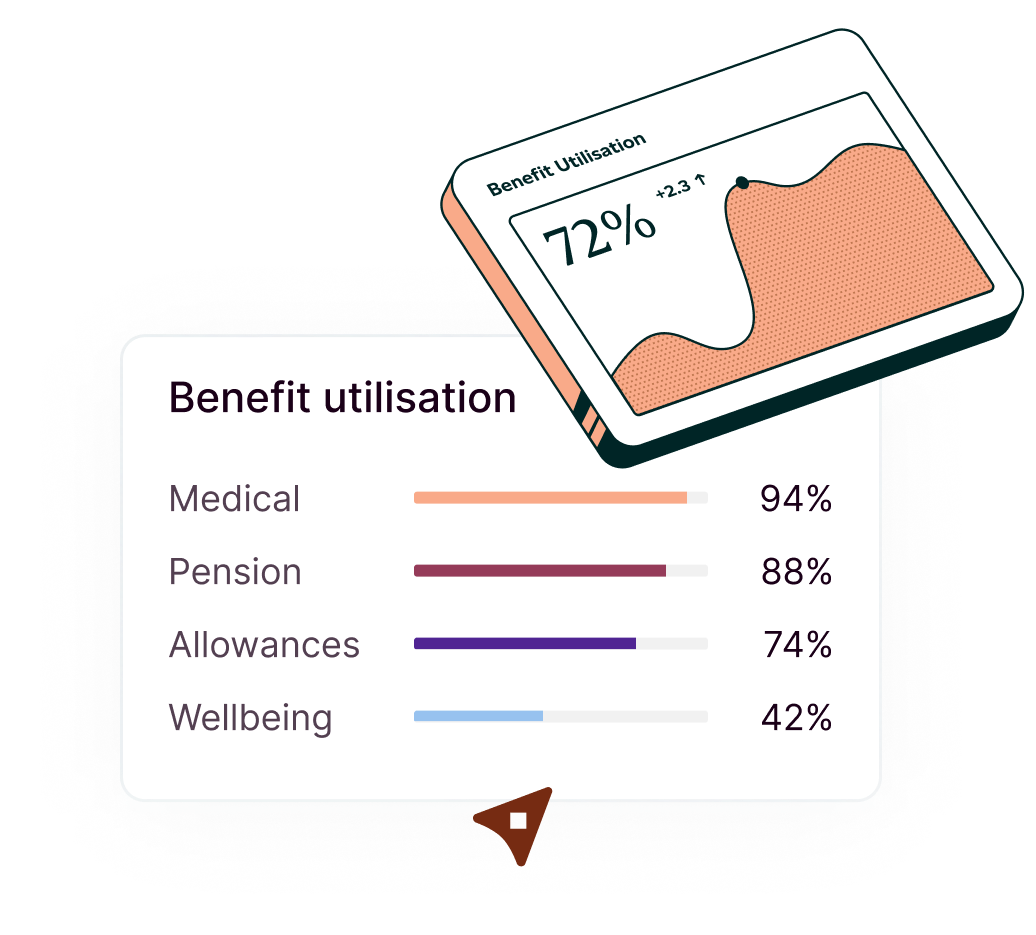
Good data is more than enrolment numbers and spend summaries. HR and finance teams need uptake by team, engagement trends over time, allowance spend at an individual and group level, and a way to benchmark against comparable organisations. Without that, it's hard to make the case for investment, hard to spot what isn't working, and easy to keep renewing benefits that nobody uses.
Happl gives HR and finance teams a live view of their programme: which benefits are performing, where spend is sitting unused, and how engagement compares to similar companies by size, industry, and funding stage. The data is there to act on, not just to report. Happl's team also actively identifies savings opportunities, flagging where cheaper alternatives exist and what those savings look like in real terms.
4. Personalisation: The same package isn't a benefit for everyone
Useful benefits look different for a 25-year-old in London to a parent of three working remotely in another country. When every employee gets the same package regardless of who they are or what they need, a significant portion of that spend will have no impact.
Personalisation isn't about building bespoke plans from scratch for every individual. It's about using the data you already have – role, seniority, location, life stage – to make sure the right benefits reach the right people. Happl's rules engine handles this automatically: flexible budgets by team or level, with eligibility logic that adjusts based on employment type or geography.
The result is an engagement rate above 90% across Happl customers. Benefits that feel relevant get used. Benefits that don't, regardless of how much they cost, get ignored.
5. Visibility: If people can't find it, they won't use it
Less than a third of employees say they fully understand their benefits but 73% say benefits matter more than their pay. When great benefits are invisible, there’s a tangible impact on retention and employee satisfaction.
Part of the problem is fragmentation. When employees have to log into separate portals for health cover, flexible allowances, and pension, most won't bother. And many employees only hear about their benefits during annual enrolment windows, so when they actually need something, they don't know where to start.
Happl puts everything in one place, available in 70+ languages, with benefits surfaced to each employee based on what they're actually eligible for. The AI assistant lets employees ask questions the way they'd ask a colleague – 'what does my health cover include for mental health?' or 'how do I use my learning allowance?' – and get an immediate, accurate answer.
An infrastructure that works for you
Most benefits programmes aren't failing because of the benefits. They're failing because the infrastructure behind them isn't built to deliver. Getting that infrastructure right is what turns a benefits budget into something employees actually value.
Book a demo to see how Happl does it.
Offer true flexibility to your team today
See how Happl runs spend allowances at scale, with eligibility, spend controls and payroll reporting automated across every market you operate in.