How to manage employee benefits across multiple countries


Managing employee benefits across multiple countries means meeting each country's own rules on pensions, insurance and tax, while keeping one standard for everyone who works for you.
In many companies, each local office has set up its own benefits, with its own broker and providers. So head office often can't say who is covered by what, or what it all costs.
The answer is to keep the basics the same everywhere, not the whole package. Set a minimum every employee gets, wherever they work and whoever employs them. Meet each country's mandatory benefits underneath it, and let local choice sit on top. Then run every country from one place, with each benefit set up for the market it runs in.
What's mandatory varies more than most people expect. In the UK, employers pay at least 3% of qualifying earnings into a workplace pension. In Singapore, the employer's contribution to the CPF, the country's compulsory savings scheme, is 17% for most staff.
We cover what's mandatory where, how to keep benefits consistent, EOR staff, what to ask of a global platform and how to bring every country into one system.
What does managing employee benefits across multiple countries involve?
Managing benefits across multiple countries means running a different set of mandatory benefits, tax rules, providers and payroll in each market, while keeping one view of who's covered and what it costs.
Five things change from one country to the next:
- Mandatory benefits. What the law says employers must provide, such as pension contributions, some types of insurance and paid leave. What's required, and how much, changes from country to country.
- Tax treatment. The same benefit can be taxed as pay in one country and tax-free in another, so what an employee takes home differs even when the benefit is identical.
- Providers and brokers. An insurer that works well in one market may not operate in the next, so each country usually has its own.
- Payroll and currency. Deductions and reporting go through each country's payroll, and people are paid in their own currency.
- What people expect. Some benefits are standard in one country and unusual in another. Employees compare their package with other employers in their country, not with head office.
Handling these differences is hard enough. It gets harder when each country's office handles them on its own, with its own broker and providers. Then a simple question from head office, like how much you spend on medical cover across every country, means chasing each office for an answer.
Which employee benefits are mandatory in each country?
Every country has its own rules on what employers must provide. They usually cover four things and the detail changes from country to country.
- Retirement. Most countries require employers to pay into a pension or state scheme, such as automatic enrolment in the UK, CPF in Singapore or superannuation in Australia.
- Health cover. In Germany, employers pay into state health insurance. In the US, employers with 50 or more full-time staff have to offer health cover or pay a penalty.
- Paid leave. EU countries guarantee at least four weeks' paid holiday a year. The US has no national minimum.
- Extra pay. Some countries require more, like a 13th-month salary in Brazil and the Philippines.
Anything above these minimums is your choice.
Take pensions. A 5% employer contribution is generous in the UK. But in Singapore, it's far short of the 17% the employer has to pay. A package built at head office breaks the first time it meets another country's minimum.
In the EU, there's one more thing to plan for. Under the Pay Transparency Directive, benefits can count as pay, so the benefits you give people in each member state matter for pay reporting too. There's more on what that means in our guide to the directive for global teams.
This is a summary of official guidance as of November 2026, not legal or tax advice. Check how it applies to your employees with your adviser or provider in each country.
How do you keep benefits consistent across countries?
Set a minimum every employee gets wherever they work, then let each country's rules and norms decide what sits on top.
A consistent package has three layers:
- A shared minimum. The minimum everyone gets, in every country. It's usually protection, like life cover and income protection, plus a pension contribution. Head office decides it once, for the whole company, based on what matters most to you, rather than each office setting its own.
- The local layer. What each country requires by law, plus what's normal there. Where the local mandatory benefit is already above your minimum, the local one applies.
- Choice on top. A flexible allowance lets people spend a budget on what matters to them, within categories you choose. There's more on setting one up in moving from a fixed package to flexible benefits.
Employers see the value of this. Rolling out global minimum standards was fourth among employers' priorities in Aon's 2025 Global Benefits Trends Study.
It's also a question of fairness. Say head office has private medical and the 12 people in the Poland team have a gym discount. Poland notices. A smaller office that gets less than everyone else reads it as a message about how much it matters. Giving everyone the same minimum shows every office it matters just as much, without matching the whole package everywhere.
Can EOR employees get the same benefits as your own employees?
EOR employees can get the same minimum as everyone else, with the EOR covering what local law requires as their legal employer and your company adding its own benefits on top.
An employer of record (EOR) is the company that legally employs someone on your behalf, usually in a country where you don't have an entity. The EOR handles their contract, payroll and the benefits local law requires. What you add above that is up to you and for most employers it should match what staff on your own payroll get.
EOR staff work for you day to day. They sit in your team meetings and do the same job as the person next to them. If their package is visibly worse, they notice.
The practical difficulty is data. Their pay and benefits information sits with the EOR provider, so it has to be brought into your view separately. It's also why EOR staff are easy to leave out of a total reward statement. If you don't bring that data in, they're missing from your benefits reporting too.
Happl supports EOR staff too. They're set up as their own group, with the same reporting as everyone else.
Is there one benefits platform that works in the UK, Europe, the US and APAC?
Several platforms say they cover the UK, Europe, the US and APAC, so ask how each country is delivered. Look into whether they are set up in the platform with its own eligibility, tax and provider, or handed to a local partner.
- How is each country set up? Ask whether the benefits are configured in the platform, with eligibility rules, tax treatment and a provider for that market, or whether a partner runs them and the platform shows the result.
- Does the US work the same way? The US is the market buyers worry about most. Ask for the same answer for the US as for the UK, not a different process.
- Is it one platform or one per country? One platform means one set of employee data. Some platforms need a separate instance for each country, or hand some countries to a partner.
- Can you keep your local providers and brokers? Moving to one platform shouldn't mean replacing the broker who knows the market. The platform should run the benefits you already have.
- What do people see? Ask about languages and whether each person sees their package in their own pay currency.
- How does it connect to each country's HR and payroll systems? Eligibility only stays right if the platform reads from the system that holds the employee record.
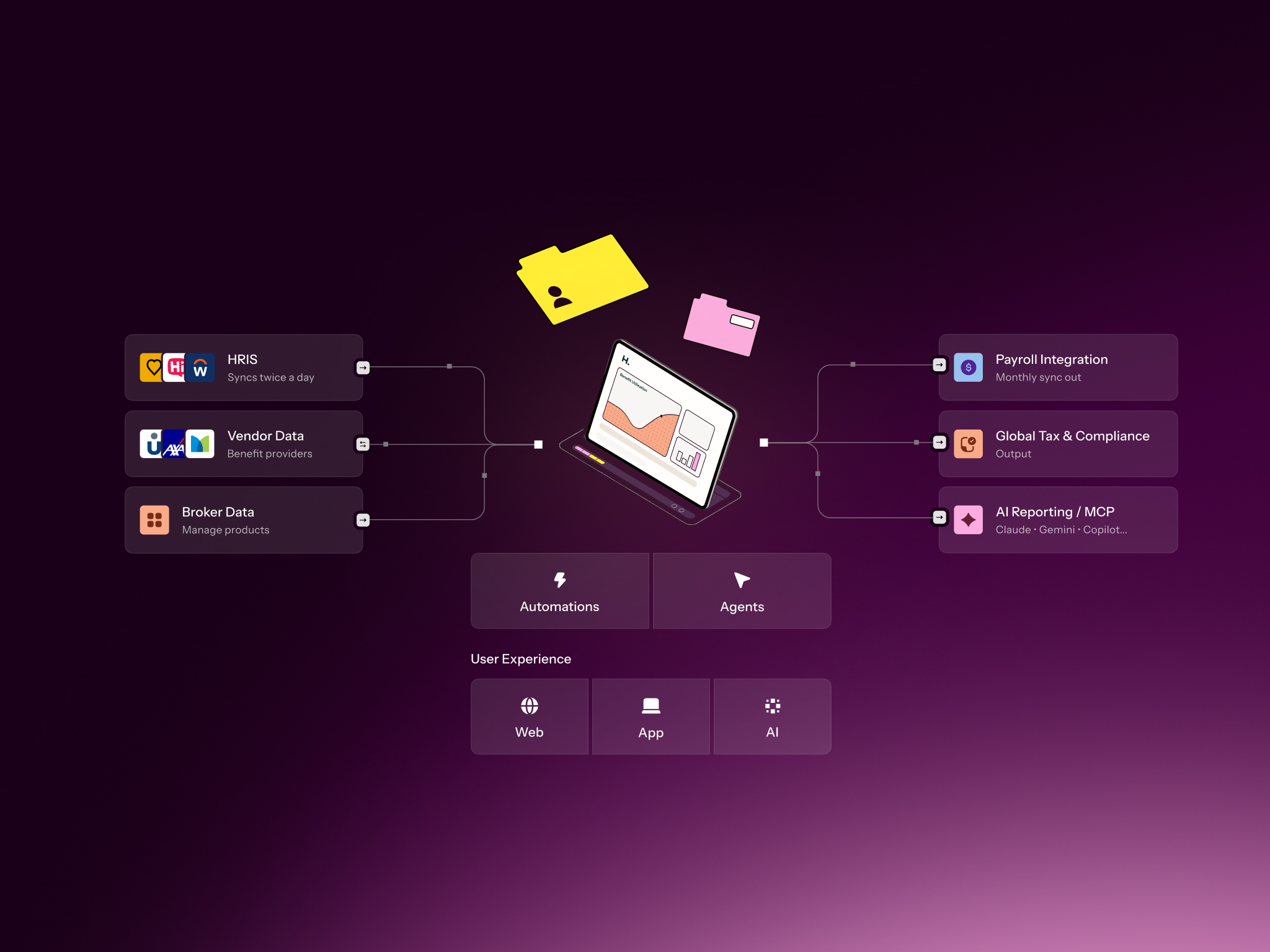
Happl is the benefits operating system for global enterprises. Each benefit is set up for the market it runs in, with its own eligibility rules, tax treatment and provider, and every market runs in one instance, so a country isn't a separate system. You can see how this works on the Happl benefits page.
How do you see total benefits spend across countries and currencies?
You see total spend across countries when every market's benefits run in one system with one set of employee data, so cost can be reported by country, provider and currency without asking each local office.
Otherwise, a request from finance for total medical spend means emailing every local office, waiting for spreadsheets in different formats and converting the currencies by hand. It's a lot of work for one number.
With one set of data the answer is already there. Each person sees their package in the currency they're paid in, and the same figures roll up for finance by country, provider and currency.
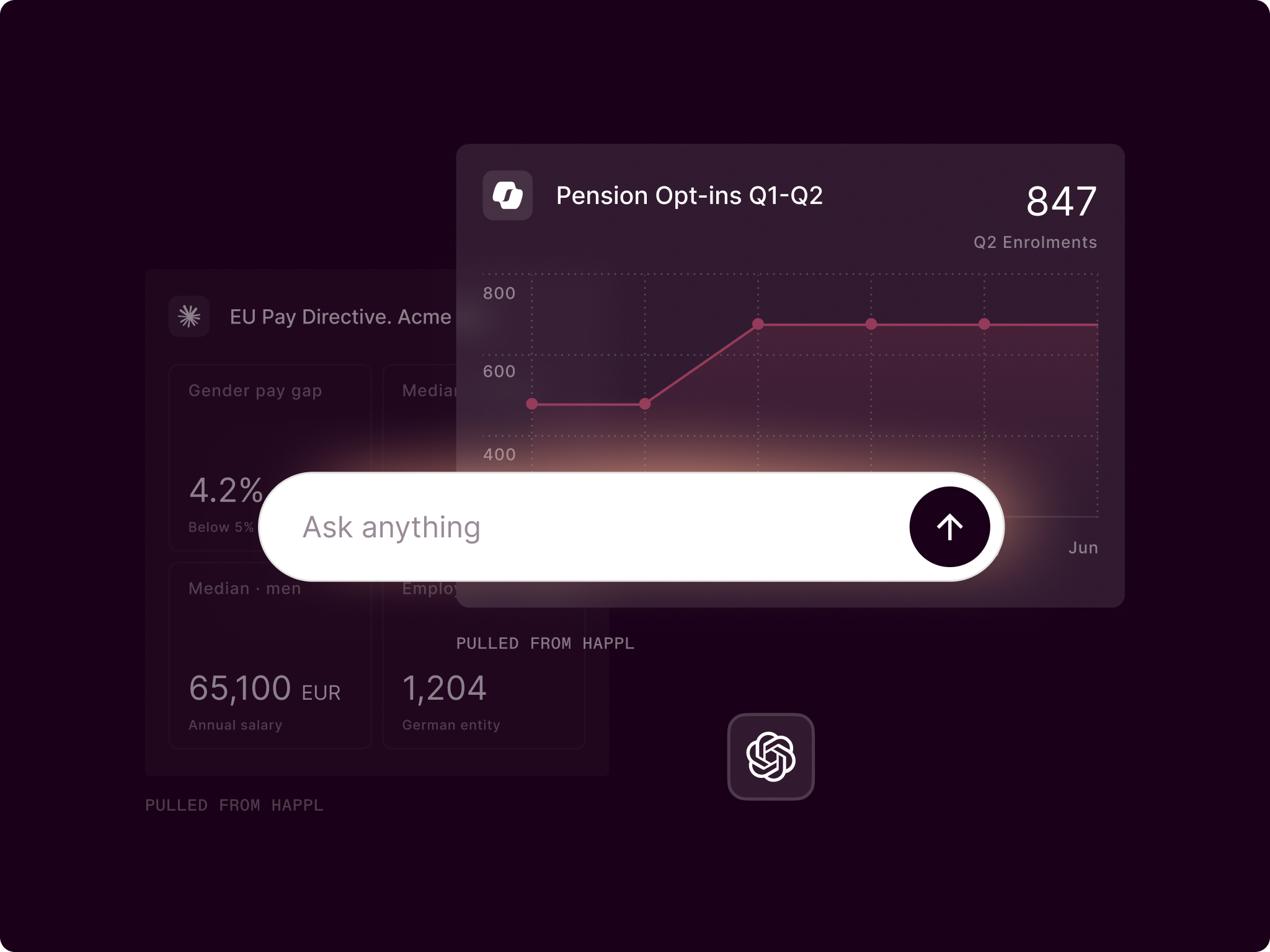
Happl MCP brings key information into the AI tool you already use, without logging in to another platform. You can ask for spend by country, then ask the follow-up in the same conversation. We cover this in Happl MCP. And because Happl connects to HR systems, the employee data underneath stays current.
When should you move global benefits off spreadsheets and local brokers?
If your global benefits run on spreadsheets, it probably happened one country at a time, as each new market was set up quickly with a local broker. It's easy to miss the point where that stops working.
Three signs it's time:
- A simple question takes a week. 'How many people are covered by private medical?' means a request to every office and a wait for the replies.
- Each country has its own spreadsheet and broker portal. The information is all there, but nobody can see it in one place.Nobody has the full picture and if the person who manages a country's benefits leaves, it's hard to know who's covered by what.
- A new country starts from a blank page. Eligibility is rewritten, a new broker is found and another spreadsheet is started.
You don't have to move everything at once. Start with head office and your biggest market, then bring each country across at its renewal. With Happl, you can bring your existing local brokers into the platform too, so you keep the people who know each market.
In Happl, eligibility is set once and adapted for each market, so adding a country means adapting rules you already have. Eligibility rules also connect to your HR system.
Running global benefits in one place with Happl
Fair global benefits come down to three things: the same minimum for everyone, the right local benefits in each country and one place to run them all.
Happl is built around this. Each benefit is set up for the market it runs in, with its own eligibility rules, tax treatment and provider. EOR staff are included, with the same reporting as everyone else, and you can bring your existing brokers with you.
Global benefits FAQs
Do you have to offer the same benefits in every country?
No. Offer the same floor everywhere and let the local layer differ. Each country's mandatory benefits, tax rules and norms mean an identical package breaks somewhere.
What benefits are mandatory for UK employers?
UK employers must enrol eligible staff in a workplace pension. As of November 2026, the employer pays at least 3% of qualifying earnings, as part of a minimum total contribution of 8% (GOV.UK).
Can EOR employees get company benefits?
Yes. The EOR covers what local law requires, and you can add your own benefits on top, so they get the same floor as everyone else.
How do you manage benefits in a country with no local HR team?
Run them centrally, from one platform with one set of employee data, and use a local broker in that country for advice on the market.
Can a global benefits platform handle different currencies and languages?
It should. Ask whether each person sees their package in their pay currency, and which languages employees can use. Happl is available in 70+ languages (Happl).
When should you add a new country to your benefits platform?
Add each country when its current policies come up for renewal, so you don't cancel cover part way through a year.
What is the best global benefits administration platform for a mid-sized company?
The best one sets up every country you employ in, with its own eligibility, tax and provider, rather than listing the most countries. Happl sets up each benefit for the market it runs in, so a mid-sized company can run the UK, Europe, the US and APAC from one place.


Offer true flexibility to your team today
See how Happl runs spend allowances at scale, with eligibility, spend controls and payroll reporting automated across every market you operate in.