
Learning and development policy template for UK employers
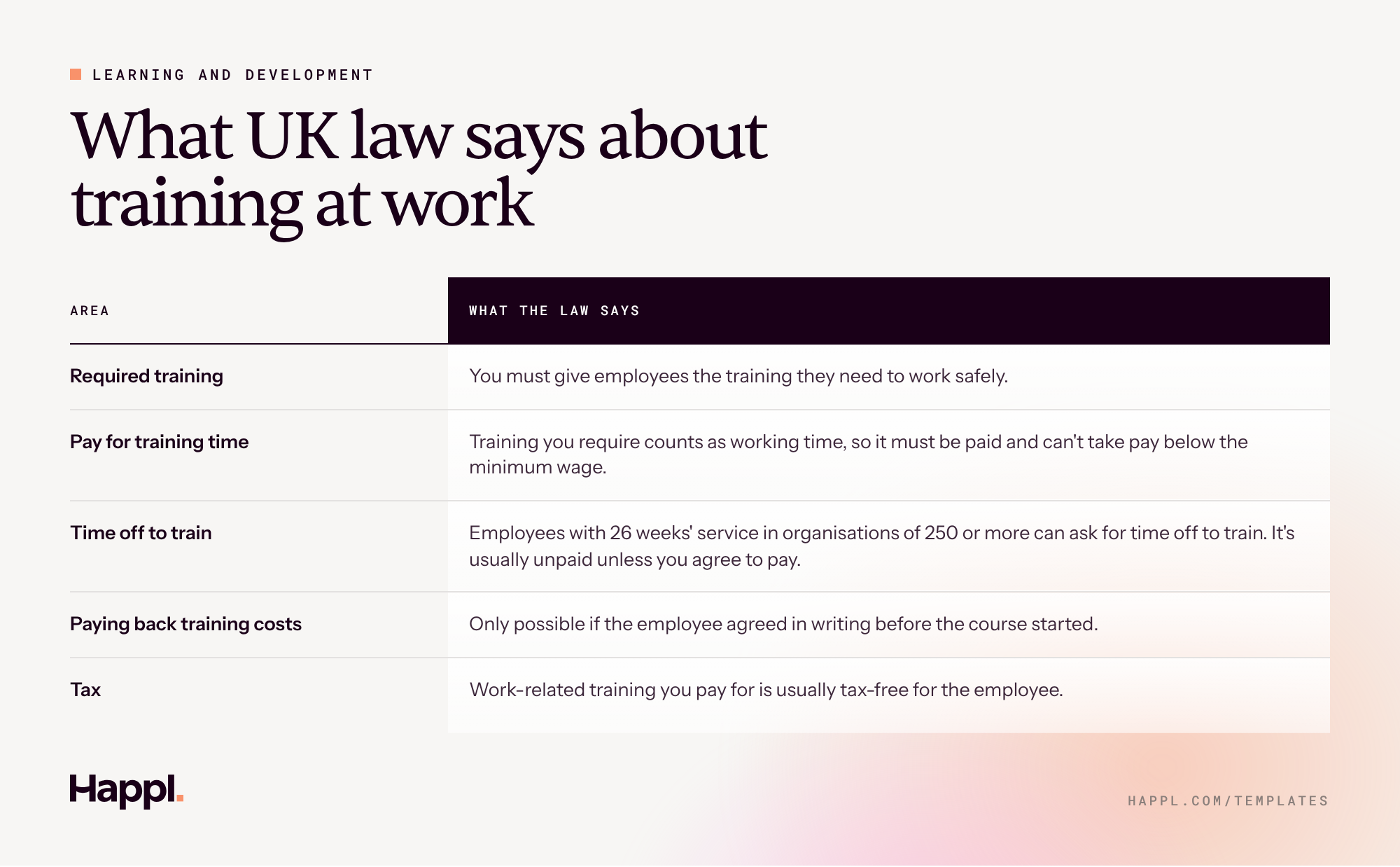
Outside the training people need to do their job safely, the law leaves learning and development up to you. That freedom is useful, but without written rules, budgets get spent unevenly and the same request gets a different answer from each manager.
Your policy should also cover training repayments. If you want people to pay back the cost of a course when they leave, they need to agree to it in writing before it starts.
What the law says
Learning budgets
A learning budget gives each person a set amount to spend on courses, books, conferences or qualifications each year. It makes learning feel like something people can act on, not something they have to make a case for.
Decide how much each person gets, what it can be spent on, whether unused budget rolls over and who approves spending. Keep the rules short, so people actually use it.
Paying back training costs
Some employers ask people to repay the cost of an expensive course if they leave soon after. You're legally allowed to ask this but only if the employee agreed in writing before the course started.
A sliding scale is fairer and easier to defend. For example, someone who leaves within 12 months repays the full cost and within 24 months repays half. You can ask for the cost of required training back too, as long as it doesn't leave someone earning less than the minimum wage.
FAQ
Does an employer have to provide training?
You must give employees the training they need to do their job safely. Anything beyond that is your choice.
Do employees get paid for time spent training?
Yes, for training you require. It counts as working time, so it must be paid at least the minimum wage.
Can employees ask for time off to study?
Yes, if they have 26 weeks' service and the organisation has 250 or more people. You can say no for a business reason, and the time off is usually unpaid.
Can an employer ask for training costs back if someone leaves?
Only if the employee agreed in writing before the course started. A sliding scale, where the amount falls over time, is fairer and easier to defend.
How much should a learning budget be?
There's no set amount. Pick a figure you can sustain every year and apply it to everyone in the same way.
Is training paid for by the employer taxable?
Work-related training you pay for is usually tax-free for the employee. Courses unrelated to their job may count as a taxable benefit.



Offer true flexibility to your team today
See how Happl runs spend allowances at scale, with eligibility, spend controls and payroll reporting automated across every market you operate in.