How to prepare for the end of P11Ds


From 6 April 2027, tax on the most common employee benefits will be collected through payroll every month, instead of being reported once a year on a P11D. HMRC calls it mandatory payrolling of benefits in kind. If you use P11Ds today, you're one of around 280,000 employers who'll need to change how you report.
P11Ds don't end in one go, though. The change comes in two stages, and some benefits stay on a P11D for a while yet. We cover what's changing and when, what employees will see on their payslips, where the benefit values come from and the steps to take before April.
What does mandatory payrolling of benefits in kind mean for employers?
Mandatory payrolling means employers report taxable benefits through payroll every pay period, instead of on a P11D after the tax year ends.
Today, most employers tell HMRC about benefits like company cars and private medical once a year on a P11D. HMRC then adjusts each employee's tax code to collect the tax. Employers pay their own National Insurance on those benefits, known as Class 1A, in one payment by 22 July.
From April 2027, the value of each benefit is added to the employee's taxable pay, so tax is taken in the month they receive it. Employers calculate and pay Class 1A through payroll every month too.
For employers, the biggest change is cash flow.
- Two payments in July 2027. You'll pay 2026 to 2027 Class 1A the old way by 22 July 2027, on top of the monthly payments that start in April. HMRC advises budgeting for both.
- A year end correction. Where a benefit's value can't be known during the year, there will be a process to correct it afterwards. The deadline for that hasn't been confirmed.
Some employers already do this. HMRC has allowed voluntary payrolling since 2016. The difference now is that it becomes a legal requirement for the most common benefits.
So if you're the person who pulls the P11D figures together each summer, you'll be doing that work every month instead.
When do P11Ds end?
P11Ds end in stages. The first wave of benefits moves to payroll on 6 April 2027, most of the rest follows in April 2028 and a few stay on P11Ds after that.
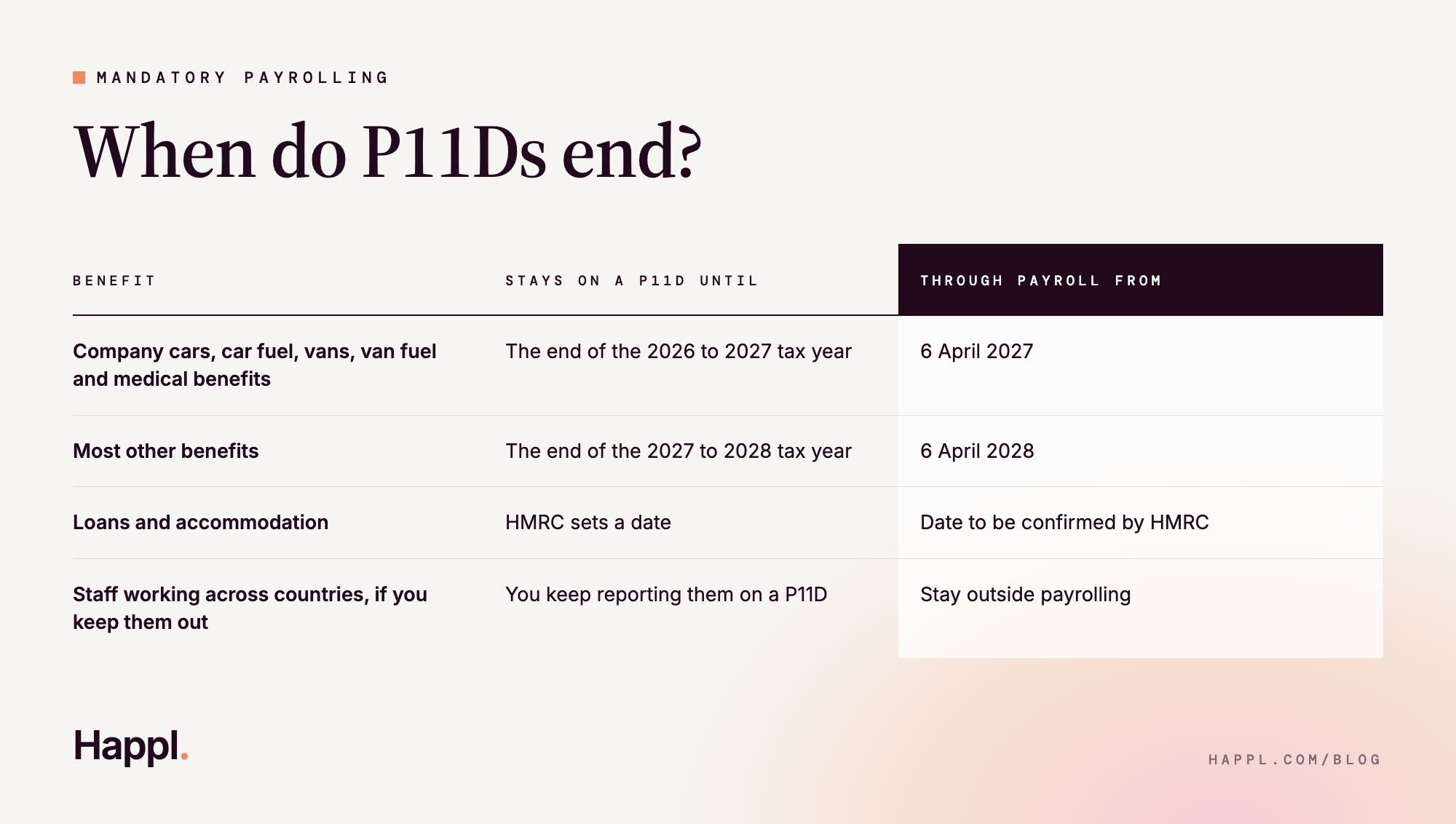
The first payrolled tax year is 2027 to 2028. You can register to payroll other benefits early.
HMRC says taxable expenses will also be phased in from 6 April 2027, but it hasn't said which ones yet.
An employer with company cars and gym memberships will run both systems for a year. Cars go through payroll in April 2027 while the gym memberships stay on a P11D.
What will employees see on their payslips?
From April 2027, employees with a company car or private medical will see those benefits on their payslip every month, with the tax on them taken through payroll.
The tax itself isn't new. They were already paying it through their tax code. What changes is where it shows up and when it's collected. HMRC's guidance lists four things employees will notice.
- Benefits on the payslip. The value of each benefit is shown on their payslip and the tax on it comes out of their pay.
- A new tax code. HMRC removes payrolled benefits from tax codes before April 2027.
- Tax paid as they go. Instead of paying tax on benefit a year later, it comes out of their pay that same month.
- Two deductions for a while. Someone still catching up on underpaid tax from earlier years will have that collected through their tax code while new tax comes through payroll. It isn't double tax, but it can feel like it.
How to explain the change to employees
Payroll owns the reporting, but the questions will come to HR. Seeing a benefit's tax every month can make people reconsider whether they want it, so explain the change before April.
- Show an example payslip. Point to where the benefit appears and the tax on it.
- Use the same words every time. HMRC suggests clear terms to separate this year's tax on benefits from catch up payments on earlier years.
- Point people to HMRC for hardship. Employees who struggle with the combined payments should contact HMRC.
How do benefit values get to payroll every month?
Payroll needs to hear about every benefit change in the month it happens. For most HR teams, that's the biggest change to their day-to-day work.
With a P11D, benefit values were pulled together once a year, after the tax year ended. From April 2027 payroll needs them before every pay run. HMRC's readiness guidance asks employers to review how benefit information reaches payroll from HR, providers and other teams.
The changes that need to reach payroll each month include:
- Joiners who become eligible for a company car or private medical
- Leavers whose car or cover ends
- Car swaps, when someone hands back one company car and takes another
- Changes to cover, such as adding a partner or children to private medical
- Flexible benefits choices, made at enrolment or after a life event
- Salary sacrifice arrangements starting, changing or stopping
If a car swap in April only reaches payroll in July, three months of payslips are wrong and someone has to fix them. That's more likely when benefits data is spread across provider portals, an HR system and a spreadsheet.
Happl keeps your benefits data up to date in one place, connected to your HR system and payroll. Its payroll report shows the date of each change and the provider's reference ID, so payroll can see what changed and when.
How do you prepare for mandatory payrolling?
You need to start now, because the first payrolled tax year starts on 6 April 2027. HMRC's readiness guidance lists nine steps. The eight actions below cover all of them, plus whether to payroll other benefits early.
1. List every benefit and its taxable value
Write down who gets each benefit, what it's worth and which phase it falls into. Include anything employees choose through salary sacrifice or a flexible allowance.
2. Agree where each value comes from and who sends it to payroll
For each benefit, name the system or provider that holds the value and the person who makes sure it reaches payroll.
3. Ask your payroll provider to confirm it can report benefits and Class 1A from April 2027
Get the answer in writing and ask what format it needs the values in. If it can't report them, you need to know now, not in March.
4. Decide whether to payroll your other benefits early
If you want to payroll benefits that aren't mandated yet from April 2027, you can register with HMRC now. If you change your mind, you must withdraw your registration by 5 April 2027.
5. Set the rules for joiners, leavers and mid-year changes
Decide what payroll does when someone joins, leaves or changes a benefit halfway through a month. Check how you'll handle fuel, staff on different pay cycles and people working abroad. Staff who work across countries can be kept out of payrolling by applying to HMRC.
6. Budget for two sets of Class 1A in 2027 to 2028
The 2026 to 2027 annual Class 1A bill is still due in July 2027. By then monthly payments for 2027 to 2028 are already running, so finance sees both in the same year.
7. Train HR and payroll on the new monthly process
Walk both teams through who sends what, by when and what to do when a value changes.
8. Tell employees what will change before April
Keep it short: benefits will appear on their payslip and come out of their tax code.
Payrolling benefits in kind FAQs
Do we still need to file P11Ds and a P11D(b)?
Yes for 2026 to 2027. For 2027 to 2028, any benefit that isn't payrolled yet still goes on a P11D, which is most benefits other than cars, vans, fuel and medical. From April 2028, that's only loans, accommodation and any globally mobile employees you except.
Can our benefits platform still run P11D reports?
You'll need them for benefits that aren't payrolled yet. Ask your platform to show you a P11D report working next to the monthly payroll report, so you can see both from the same data.
Will HMRC charge penalties for mistakes in the first year?
For 2027 to 2028, HMRC says errors related to payrolling won't attract inaccuracy penalties unless there's evidence of deliberate non-compliance. Late filing and late payment penalties can still apply.
Are the rules final?
Not yet. HMRC says its guidance will be further updated in autumn 2026. Check the gov.uk page before you act on a date or a rule.
What happens to benefits tax when someone leaves?
Tax is taken through payroll each month up to their last pay, so nothing is caught up the following year.
Do salary sacrifice and flexible benefits change under payrolling?
HMRC asks you to plan for changes in their value and doesn't say more yet. If you're thinking about moving to an allowance, our guide to moving from fixed to flexible benefits covers how each option is taxed today.


Offer true flexibility to your team today
See how Happl runs spend allowances at scale, with eligibility, spend controls and payroll reporting automated across every market you operate in.