How to move from a fixed benefits package to flexible benefits


A fixed benefits package gives everyone the same benefits, whatever stage of life they're at. So some of what you spend goes on benefits part of your team will never use, while the things they would use aren't covered.
Moving to flexible benefits lets people put that budget towards what matters to them. But it changes how your benefits are funded, how spend is controlled and how each benefit is taxed.
Flexible benefits can mean two different things. One is a menu, where people choose between set options. The other is an allowance, a budget each person spends on what they value. Moving to an allowance means deciding what stays fixed, how to fund the budget, how to control what it's spent on and how each option is taxed in the UK.
What is a flexible benefits allowance?
A flexible benefits allowance, also called a flex pot, wellbeing allowance or lifestyle spending account, is a set amount per person to spend on what they value, within categories their employer chooses.
A fixed package gives everyone the same benefits. Flexible benefits let people choose between options. A flexible allowance gives each person a budget to spend within rules you set.
The allowance renews on a schedule you choose and can be spent on anything in the categories you allow.
Fixed vs flexible benefits compared
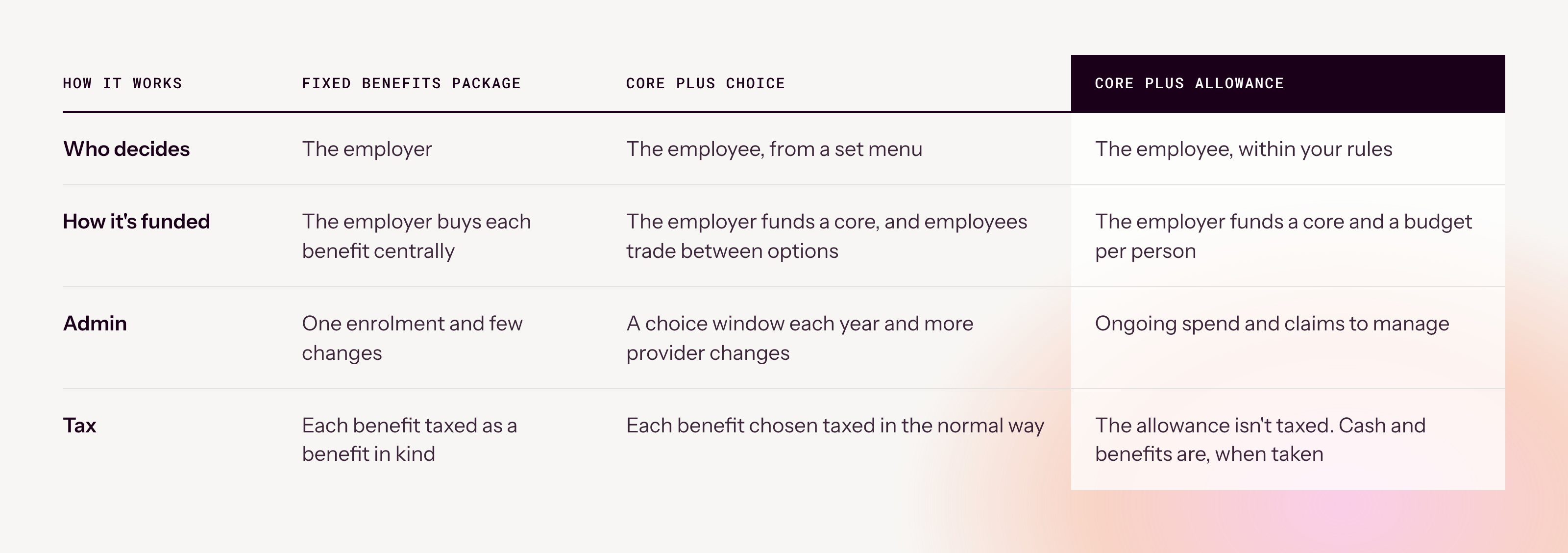
Pros and cons of flexible benefits vs a fixed benefits package
A flexible allowance fits a wider range of people, but it asks more of HR and of employees. A fixed package is simpler to run, and that's its main strength.

A fixed package works best for whoever it was designed around. A package built around family cover, for example, favours staff with families. Nobody sets out to do that, but everyone else gets less from the same budget.
The biggest risk with flex is people opting out of protection they'll need later. That's why flexible schemes usually keep a core of benefits that can't be traded away.
How to move from a fixed benefits package to an allowance, step by step
Start with what you already spend, decide what stays fixed, then move the rest into an allowance with clear rules. Phase it in rather than switching everything at once.
1. Audit what you spend and what gets used
List every benefit with its cost per head and how many people use it. The gap between the two is where your allowance budget comes from. A platform only one in ten people log into, or a health cash plan few people claim on, is budget you can move into the allowance.
2. Decide what stays in the core
Keep protection fixed. Pension, life cover and income protection are hard to replace if someone opts out and later needs them, so they shouldn't compete with a gym membership for the same budget. Workplace pension contributions are a legal requirement for eligible staff anyway. Private medical is the main judgement call. Some employers keep it in the core, others let people opt out and take the money as an allowance instead.
3. Fund the allowance from existing spend
An allowance works best when it replaces spend rather than sitting on top of it. A small pot added to an unchanged package costs you more and changes little for employees. One buyer described their £5 a month allowance as 'too small to matter'. Moving budget out of low uptake benefits gives you an amount people will notice, without adding to your costs.
4. Set the rules for what the allowance covers
Decide which categories it covers, like wellbeing, learning or home working. Then decide how often it renews and what happens to money that isn't spent. More on this in how to control what an employee allowance is spent on.
5. Check the tax on every option
Each option in your scheme can be taxed differently, and cash is always taxed as pay. Work this out before launch, because a surprise on a payslip is much harder to explain afterwards. The UK rules are in how flexible benefits and allowances are taxed.
6. Model the cost and phase it in
You don't have to move the whole package in one go. Start with a small share of your benefits budget in the allowance, see how people spend it, then grow it at your next renewal. Model the cost at each stage so finance knows what to expect.
7. Tell people what's changing and what it's worth
People can only value an allowance they understand. Explain what's still covered, how much they have to spend, what it can go on and how they pay. We've written about why communication is one of the biggest barriers to benefits engagement.
How to control what an employee allowance is spent on
Set rules by category and have them checked at the moment money is spent, not afterwards. That way the allowance stays flexible without someone reviewing every purchase.
Card or reimbursement. A spend card is quick, because people pay at the till like any other card. A reimbursement is controlled, because someone checks the receipt before money goes out, but that means someone has to approve every claim. You shouldn't have to pick one. When the rules sit behind the allowance, the card declines anything outside your policy, so people get the speed of a card and you keep the control of a claim. In Happl, people can pay with a virtual or physical card, including through Apple Pay and Google Pay, or pay upfront and claim it back with a receipt.
Category rules. Allow or block types of merchant, like gyms, bookshops or travel. Happl checks each card payment in real time against the allowed categories, the person's remaining balance and the company's available funds.
Renewal and rollover. Choose whether the budget renews monthly, quarterly or yearly, and whether unspent money rolls over or clears. Rollover lets people save up for something bigger. Clearing keeps your costs predictable.
Write the rules for how most people will use the allowance. If every rule is designed around the one person who might misuse it, you've rebuilt the fixed package with extra steps.
How flexible benefits and allowances are taxed in the UK
The allowance itself isn't taxed, but what people take from it is. Any part taken as cash is taxed as pay, and any benefit chosen is taxed the same way it would be in a fixed package.
HMRC sets this out in its guidance on flexible benefit plans. Its example is a £2,000 allowance, where an employee spends £1,700 on benefits and takes £300 as cash. The £300 goes through PAYE and Class 1 National Insurance. The £1,700 of benefits are taxed as benefits in kind in the normal way.
Salary sacrifice works differently. If people can top up their allowance or pick benefits by giving up salary, that's a salary sacrifice, also called an optional remuneration arrangement. Only a few benefits keep their tax advantage this way: pension contributions, pensions advice, workplace nurseries, cycle to work schemes and childcare arrangements that started before 4 October 2018. Everything else is taxed on whichever is higher, the salary given up or the normal benefit in kind value (HMRC).
One buyer we spoke to found their wellness top up was being taxed as salary for exactly this reason. It's worth checking before you design your scheme.
What changes from April 2027. Employers will have to report benefits through payroll in real time, instead of on a P11D at the end of the year. Medical benefits, company cars, vans and fuel come first, from 6 April 2027. Most other benefits follow from 6 April 2028. Class 1A National Insurance will be worked out and reported in real time too (HMRC).
For flexible benefits, that means the tax on each choice will show on payslips every month. People will want to see what an option costs them in take home pay before they pick it. In our demos, buyers asked whether employees can model the impact on their pay 10 times across 4 companies. Happl works out what's taxable on each allowance and reports taxable and tax free spend to payroll, so the figures are ready when payroll needs them.
This is a summary of HMRC guidance as of October 2026, not tax advice. Check how it applies to your scheme with your payroll team or adviser.
What to look for in a flexible benefits platform
Look for a platform that runs the allowance alongside the rest of your benefits, so people see their whole package in one place and payroll gets one set of figures.
- Spending rules by category, checked when people pay rather than after
- Card and reimbursement in one place, so people can pay either way from the same balance
- Tax worked out for you, with taxable and tax free spend reported to payroll
- HRIS integration, so eligibility and budgets update when someone joins, leaves or changes role
- Cover outside the UK, if you employ people in other countries
Tax rules on allowances differ from country to country, so a scheme designed for the UK won't simply copy across. Happl is used in 160+ countries, its allowance cards work wherever people are, and it connects to 100+ HR and payroll systems to keep eligibility up to date.
Flexible benefits FAQs
Are flexible benefits taxable?
The allowance itself isn't. Benefits people choose with it are taxed as benefits in kind, and anything taken as cash is taxed as pay. If someone pays for a benefit by giving up salary, the salary sacrifice rules apply instead.
Can employees take a flexible allowance as cash?
They can if your scheme allows it, but cash is taxed as pay through PAYE and National Insurance. Benefits bought with the allowance are taxed as benefits in kind instead.
What happens to an unspent allowance?
It depends on your rules. You can let the balance roll over to the next period or clear at the end of it. If you pay unspent money out as cash, it's taxed as pay.
How much should a flexible benefits allowance be?
There's no standard figure, because the right amount depends on what the allowance replaces. Among the companies we've spoken to, allowances ranged from £5 to £70 a month. Start with what you spend today on benefits with low uptake and work from there.
Can employees top up their allowance from their salary?
Yes, but a top up from salary is a salary sacrifice. Unless it goes on pension, cycle to work or one of the other exempt benefits, it's taxed on the salary given up or the benefit's value, whichever is higher.
Do I still need a P11D for flexible benefits after April 2027?
Not for medical benefits, company cars, vans or fuel, which must be reported through payroll from 6 April 2027. Most other benefits move to payroll from 6 April 2028. Employer provided loans and accommodation stay on year end reporting for now.
What's the difference between flexible benefits and salary sacrifice?
Flexible benefits are funded by the employer, as a core package with choices or an allowance per person. Salary sacrifice means an employee gives up part of their salary in exchange for a benefit. Only a few benefits keep a tax advantage that way, including pension contributions and cycle to work.
What is a lifestyle spending account?
It's another name for a flexible allowance. Each person gets a set amount to spend on things like wellbeing, learning or home working, within the categories their employer allows.
Setting up a flexible allowance with Happl
Moving to flexible benefits takes more thought up front than renewing a fixed package. But once the rules are set, an allowance puts your benefits budget where your people want it. See how Flex Spend Accounts work in Happl.
Offer true flexibility to your team today
See how Happl runs spend allowances at scale, with eligibility, spend controls and payroll reporting automated across every market you operate in.