
Flexible working policy template for UK employers
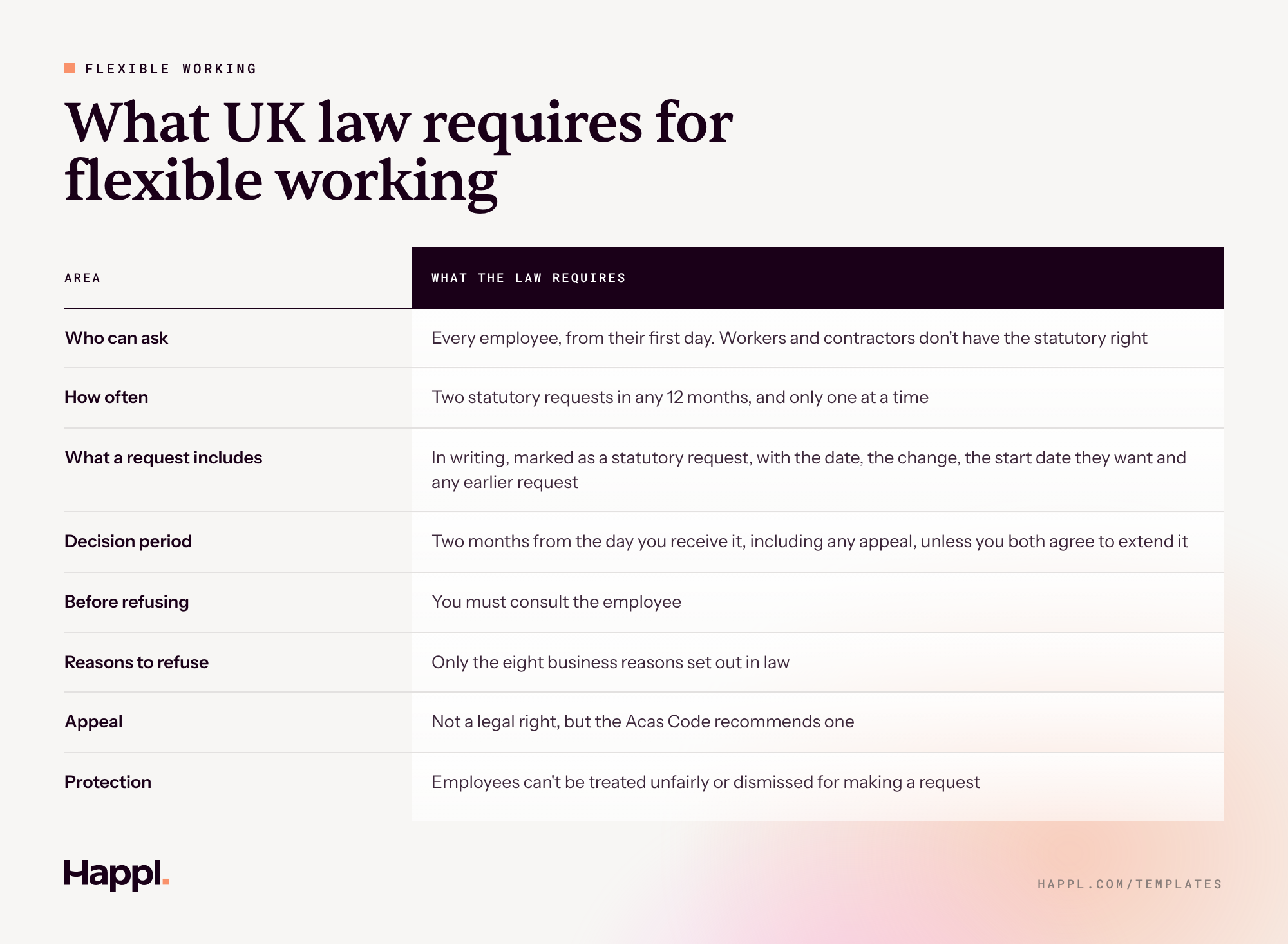
Every employee in the UK can ask for flexible working from their first day. Employers can only refuse for one of eight business reasons set out in law. Before refusing, you must discuss the request with the employee.
The rules are changing. Under the Employment Rights Act 2025, a refusal will also have to be reasonable, with the change expected in autumn 2027.
Our policy is written for today's rules and ready for 2027, with a simple form employees can use to make a request.
What the law requires
The eight reasons to refuse
These are the only reasons you can use to say no, taken from the Acas Code.
- The burden of additional costs. Put a figure on the extra cost the change would bring.
- An inability to reorganise work among existing staff. If the change leaves hours uncovered, such as Fridays after a move to four days a week, show that no one else in the team can pick them up.
- An inability to recruit additional staff. Show what recruiting for any gaps would involve.
- A detrimental impact on quality. Point to the standard that would slip.
- A detrimental impact on performance. Point to the measure that would fall.
- A detrimental effect on ability to meet customer demand. Show when customers need someone available, such as opening hours, and how the change would leave those times short-staffed.
- Insufficient work for the periods the employee proposes to work. Show the workload for those hours.
- Planned structural changes. Name the change and when it happens.
What is changing in 2027
Under the Employment Rights Act 2025, having one of the eight reasons won't be enough on its own. Your refusal will also have to be reasonable, and you'll need to explain why. The change is expected in autumn 2027, but the date isn't confirmed.
Regulations are expected to make three steps mandatory before you refuse. Invite the employee to a meeting in writing, hold it with the aim of reaching agreement, and send a written summary of the outcome afterwards.
Acas is consulting on a revised Code of Practice until 17 December 2026. It asks employers to base decisions on evidence, consider changes that would make a request work, look for solutions together and stay consistent. Until the new Code is in force, the current one applies.
Handling a request, step by step
You have two months from receiving a request to give a final decision, including any appeal.
- Log the request. Note the date you received it. The two months start then.
- Check you can agree. If you can, confirm it in writing with the start date.
- Meet before you refuse. Talk through the request, your concerns and other options, such as a different pattern or a trial.
- Decide and write it down. Confirm the outcome in writing. If you refuse, name the business reason and explain it.
- Hear any appeal. Someone not involved in the first decision considers it and replies in writing.
Flexible or hybrid
Flexible working and hybrid working policies are related, but they cover different things. A flexible working policy covers how someone asks to change when, where or how much they work. Asking to work from home two days a week is one of those requests, so this policy covers it.
A hybrid working policy covers what happens once someone works that way, such as equipment, expenses and how often they come into the office. You can set this out in a separate policy.
FAQ
Who can ask for flexible working?
Every employee, from their first day of work. Workers and contractors don't have the statutory right, but you can let them use the same process.
How many flexible working requests can an employee make?
Two statutory requests in any 12 months. They can only have one request live at a time.
How long does an employer have to respond to a flexible working request?
Two months from the day you receive it, including any appeal. You can extend that if you both agree.
What are the reasons an employer can refuse flexible working?
There are eight, including additional costs, an inability to reorganise work and a detrimental effect on customer demand. You can't refuse for any other reason.
Do you have to meet an employee before refusing their request?
You must consult them before you refuse. A meeting is the usual way to do it, and it is expected to become a legal requirement from autumn 2027.
Is there a right to appeal a flexible working decision?
There is no legal right to appeal. The Acas Code recommends offering one, and the template includes an appeal clause.
What changes under the Employment Rights Act 2025?
A refusal will have to be reasonable, and you will have to explain why. The change is expected in autumn 2027.
Can you agree a trial period?
Yes. You and the employee can agree a trial and extend the decision period to cover it, as long as you both agree in writing.



Offer true flexibility to your team today
See how Happl runs spend allowances at scale, with eligibility, spend controls and payroll reporting automated across every market you operate in.