
How benefits platforms use AI and keep your data safe


AI is part of daily workflows now, in every industry. It isn't a chatbot off to the side any more. It sits inside the tools your team already uses, connected across the systems that hold your data, and it's becoming the expected way of working.
But benefits teams hold the most sensitive data in the business: salary, pension contributions, health cover and dependants. Nobody wants any of that exposed, so when you give a platform access to it, you want to know it's secure.
Your benefits platform already sits on top of your core systems, pulling from your HRIS, your payroll and your insurer policies. AI is a smart layer on top of that, working with what's already connected.
When a platform tells you it uses AI, that doesn't mean it has built its own model. Like most AI tools, it's built on top of an existing model, so your employee data is being sent to a model from OpenAI, Anthropic, Microsoft or Google, and an answer is coming back.
What's worth understanding is how your platform and the model interact, what travels between them and what keeps that safe.
What work does AI do on a benefits platform?
There are three main kinds of work we see currently when AI is connected to a benefits platform.
Employee engagement. Employees can use AI chat to help understand their benefits. They can ask AI questions like they would a colleague, then AI helps interpret complex benefit documents and insurance underwriting, and explain eligibility in simple English we all understand.
Spotting signals. AI can support strategic work by spotting signals in benefits engagement, so your team can see where something is worth changing.
Real-time centralised benefit management. AI ingests data and invoices from your vendors, then cross-checks against Happl benefit data so your systems stay up to date. Anything that doesn't match is raised for your team to action rather than corrected automatically. It can also look ahead. Your enrolment, premiums and invoice history are already in the platform, so it can show what your benefits are likely to cost at renewal and what shifts when headcount moves.
What information is sent between your benefits platform and AI?
If your benefits platform has AI capabilities, it will most likely work with an AI model (think Claude, ChatGPT or Google Gemini) and call it over an API, which is one piece of software asking another for something. It's the same mechanism your HR system already uses to talk to payroll.
When you connect your HRIS to Happl, your benefits data syncs between the two, so a copy of your employee records sits within both platforms.
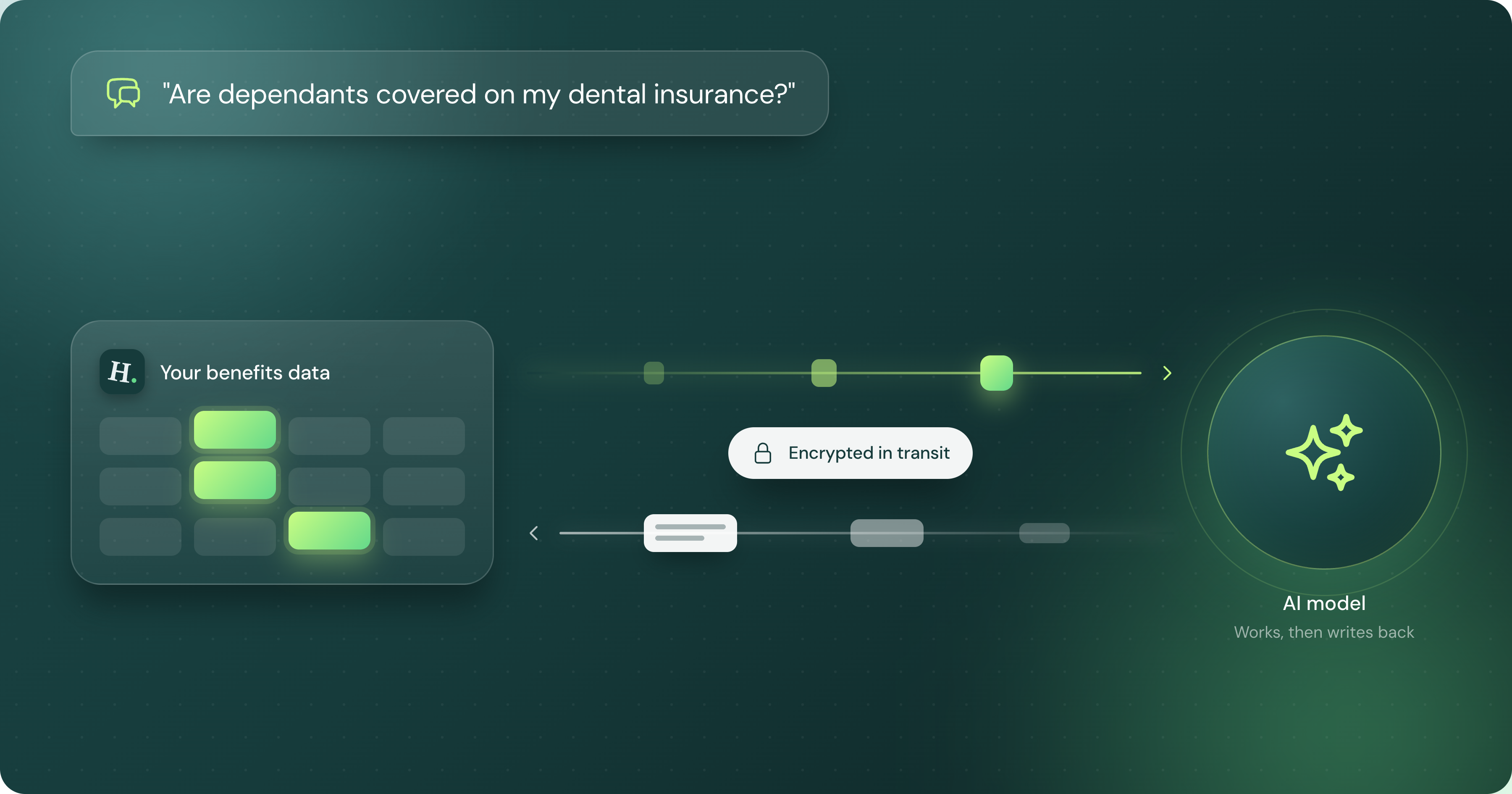
This is not needed for a model to work, so your data does not sit within the model. Instead, your benefits platform works out what information is needed to answer a question and sends that.
An employee asking what they're covered for needs their own entitlement and the rules of their scheme. Recalculating eligibility after a promotion needs that person's new grade and the rules that depend on it. Checking an invoice needs the headcount the provider is billing for and the list of who's actually enrolled.
The model sends back content. Your platform decides what to do with it. For example, if someone asks a question, they'll see the answer with information limited according to their permissions or role. Or if the AI request is part of a bigger task, the platform uses the response to take the required action, like updating an employee's eligibility.
And crucially, your information is kept safe in transit. When a request is sent, it's authenticated with a credential your platform holds, so it can only come from that account, and it's encrypted. Anyone intercepting the traffic between the two sees nothing they can read.
What happens to your data when it reaches the model?
After AI answers a request, the data doesn't disappear from the model straight away. So it's worth understanding what data is held, how long for and whether it's used in any way.
Training. There's a lot of talk about what AI models are trained on. In practice, a good benefits provider will be on business or enterprise terms with any model it calls, so your data is not involved in training.
The risk sits closer to home. Data in personal accounts can be used to train models, so it matters that your own team is only using approved tools. And it's not enough for your team to just turn off the training setting on their personal accounts. Any time company data is taken out of your systems and uploaded elsewhere, it's out of your control and a security risk.
Retention. After a request is sent, model providers keep a copy of it for a short window. This isn't to gather information about your business. It's so they can catch people misusing the service, which is hard to do without being able to look at what was sent. OpenAI keeps API requests for up to 30 days and then deletes them. Anthropic has reduced API log retention from 30 days to 7 days, and those logs are never used for model training. Whatever is being held is encrypted the whole time it's there, in the same way your records are encrypted inside your benefits platform.
Human review. While a request is sitting there, almost nobody can read it. Access isn't someone at the provider opening a file. It happens when an automated check flags something, through a controlled route, and every instance is recorded.
When the connection runs the other way
Everything above is your platform calling a model. But with Happl you can now connect your benefits data directly into the AI model your business uses day to day.
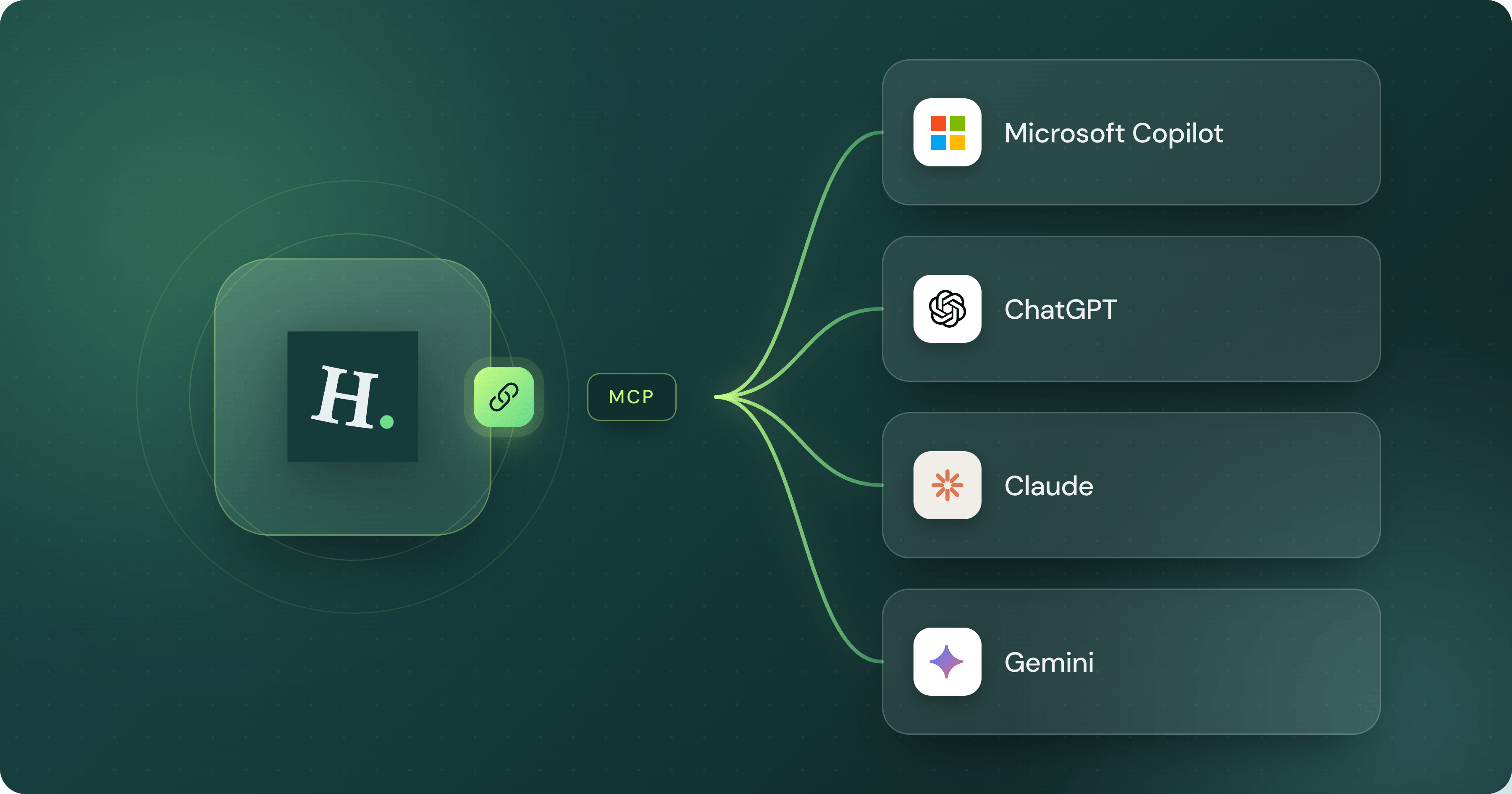
Instead of going into your benefits platform to find the information you need, you can ask the question directly in your AI assistant, like Microsoft Copilot or Claude. The assistant goes and fetches the answer. For example, someone in Copilot asks what a team's benefits cost this quarter, and Copilot gets it from the benefits platform and answers in the window they were already working in.
It works through MCP, or Model Context Protocol. MCP isn't AI. It's a standard way for an AI assistant (like Copilot or Claude) to connect to another system's API. So when you connect Happl MCP, the AI doing the work is the one your organisation has already approved, but now it can directly access information or files needed to answer questions about your benefits data.
Happl MCP is read-only so it pulls information but won't change a record, update a setting or alter a benefit selection.
It also respects the permissions you've already set up, so your team only sees the information they need for their roles.
What your team can do to work safely with AI
As well as making sure your benefits platform has the right protocols in place, your own team can do a few things to keep working safely with AI.
Only use approved AI tools. You only want company data going into the tools you've vetted and trust. Once it leaves your systems, it's out of your control, and if your team is using personal accounts, those tools may be using your data to train their models. It's worth checking what your team is actually using, because people sign up to things themselves when approved tooling doesn't do what they need.
Keep permissions up to date. Your permissions decide what AI will show each person. That used to be about who could run which report. Now someone can ask a question directly in their AI tools, and the model needs to know which permissions to apply so nobody sees data they shouldn't.
Don't skip the human review. AI can prepare a change, draft a message or flag a mismatch. You need to be clear about which tasks need a person to check them before anything is actioned.
Good use of AI makes benefits much easier to manage and access
AI is speeding up the way everyone works and your benefits platform should be helping you use it.
That doesn't mean trusting every tool that calls itself AI-powered. It's worth knowing what sits behind the label: which systems are talking to each other, what travels between them and what keeps that safe on the way.
So ask for the details. Any provider should be able to show you their architecture and data flow diagrams, which set out what connects to what and where your data travels. That's how you see whether it's as close to a closed loop as it should be.
At Happl, suppliers and subcontractors are vetted in line with our ISO 27001 certification. We're on commercial terms with every model we call, so nothing we send is used for training. And your data remains encrypted throughout the whole process. These are just some of the steps we take to ensure industry-leading AI data privacy.
Book a demo and we'll take you through it.
Offer true flexibility to your team today
See how Happl runs spend allowances at scale, with eligibility, spend controls and payroll reporting automated across every market you operate in.